Hey (: Here's the 2nd part of the xkcd.com Physics definitions notes(:
 LIGHTLuminous
: gives off light
Non-Luminous: does not give off light
Incident Ray: Light ray hitting reflective surface
Point of Incidence: Point on reflecting surface where light ray hits
Normal: Perpendicular to surface at point of incidence
Reflected Ray: Light ray reflected from reflective surface
Angle of Incidence: Angle between incident ray and normal
Angle of Reflection: Angle between reflected ray and normal
1st Law of Reflection: Incident Ray, reflected ray and normal to the reflective surface all lie on the same plane
2nd Law of Reflection: Angle of incidence is equal to angle of reflection
Characteristics of Plane Mirror Images: virtual, upright, laterally inverted, same size as object, distance of image from mirror = distance of object from mirror
Refraction: Bending effect of light as it passes from 1 transparent medium into another.
Refractive Index: Ratio between speed of light in air or vacuum and speed of light in a medium (e.g. water's refractive index is 1.33)
Critical Angle: Angle of incidence in the obtically denser medium for which the angle of refraction in the less dense medium is 90º
Total Internal Reflection: phenomenon whereby angle of incidence in a medium is increased beyond critical angle and hence light ray is reflected back into the medium (can only occur from denser to less dense)
Convex Lens: Lens which converges rays of light that pass through it
Principal Axis: A line which passes symmetrically through the optical centre of the lens
Optical Centre: Centre of lens where any ray passing through will not be deviated
Focal Point: Point at which all rays parallel to principal axis converge to after refraction by lens
Focal Length: Distance between optical centre and focal point
Focal Plane: Plane which passes through focal point and is perpendicular to principal axis
 WAVESPeriodic Motion
: Motion repeated at regular intervals
Oscillation: 1 complete motion - from one extreme position to the other extreme position
Transverse Waves: Waves that travel in the direction (displacement of particles) perpendicular to the direction of vibration.
Longitudinal Waves: Waves that travel in the direction (displacement of particles) parallel to the direction of vibration
Compressions: In longitudinal waves, regions where air pressure is higher than surrounding air pressure
Rarefactions: In longitudinal waves, regions where air pressure is lower than surrounding air pressure
Crests: Highest points of transverse waves
Troughs: Lowest points of transverse waves
Phase: Any 2 points that move in the same direction and have the same speed and same displacement from rest position
Wavelength: Shortest distance between any 2 points in a wave that are in the same place in metres
Amplitude: Maximum displacement from rest (height of crest or depth of trough) in metres.
Period: Time taken for one point on a wave to move 1 complete oscillation
Frequency: Number of complete waves produced per second in hertz.
Wave speed: Distance traveled by wave in 1 second (m s-1)
Wavefront: Imaginary line on a wave that joins all points that are in same phase.
ELECTROMAGNETIC WAVESHAHA TOO BAD, I don't have definitions for this, although I have a feeling I should wait I'll go check, otherwise the rest of it from xkcd.com (: Oh, hm. There aren't any!
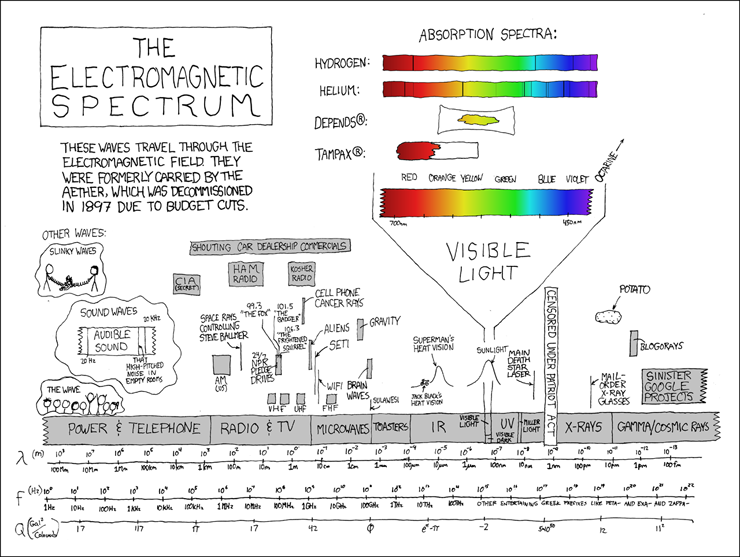
The EM waves part is actually accurate! I mean, the obviously serious parts. I trust your discernment.
SOUNDSound: Produced by vibrating sounds placed in a medium (travels fastest in solids as particles are closest together) and sound waves are an example of longitudinal waves.
Audible Sound by humans; 20-20,000Hz (below 20Hz - infrasound, and above 20,000Hz - ultrasound)
Echo: Reflection of sound
Distinct Echo: Can hear
Non-distinct Echo: Cannot hear, reverberations
Laws of Reflection apply to sound;
1. Incident, reflected wave, and normal to reflecting surface lie on the same plane
2. Angle of incident sound wave = angle of reflected sound wave
Pitch: Related to frequency. Higher frequency, higher pitch.
Loudness: Related to amplitude of sound wave. Louder, higher amplitude.
 STATIC ELECTRICITYElectrostatics
: Study of static electric charges
1 Coulomb: Quantity of electric charge that passes through a section in a circuit when a steady current of 1 ampere flows for 1 second
Electric Field: Region where electric charge experiences an electric force
Electric Fieldline: Plane in which positive charges are placed
Direction of Field: Direction of fore on a small positive charge
Strength of Electric Field: Indicated by how close the field lines are to each other.
CURRENT ELECTRICITYElectric Current: Measure of the rate of flow of electric charge through a given cross section of a conductor.
Volt: Potential difference between 2 points in a circuit is 1 V if 1 joule of electrical energy is changed to other forms of energy when 1 coulomb of charge passes from 1 point to another.
Electromotive Force: Energy given to 1 coulomb of charge so that it can travel around a complete circuit.
Potential Difference between 2 points: work done in moving 1 coulomb of charge from 1 point of lower potential to a point of higher potential.
Resistance: Ratio of potential difference across to current flowing through a component.
Resistivity: How difficult it is for an electric current to pass through a material
Ohm's Law: Current passing through a metallic conductor is directly proportional to the potential difference across its ends, provided the physical conditions are constant (e.g. temperature)
Resistance Depends On1. Length
2. Cross Sectional Area
3. Type of Material
D.C. CircuitsElectric Current: Measure of the rate of flow of electric charge through a given cross section of a conductor.
Potential Divider: Circuit with resistors arranged in series
Transducers: Electronic devices htat convert energy from 1 orm to another
Input Transducers: Convert non-electrical energy to electrical energy (e.g. thermocouples, pressure sensors, thermistors)
Output Transducers: Convert electrical energy to non-electrical energy (e.g. lamps, loudspeakers)
Light Dependent Resistor (LDR): Device that has resistance that varies with amount of light shining on it (Textbook one: higher resistance with less light). Used in lightmeters.
Thermistor: Device which changes resistance when temperature changes. (Textbook one: higher resistance with lower temperatures). Used in digital thermostats, fire alarms.
Semiconductor Diode: Device which allows current to flow easily in 1 direction
PRACTICAL ELECTRICITYCircuit Breakers: Safety devices that can switch off the electrical supply in a circuit when there is an overflow of current or small leakage current to earth
Fuses: Safety device included in an electrical circuit to prevent excessive current flow. Works together with Earth Wire.
Switches: Must be fitted onto live wire (switching off disconnects the high voltage from appliance)
Earth Wire: Low resistance wire usually connected to the metal casing of appliance and provides a conducting path for the current to flow to earth should the metal case suddenly become 'live'.
Double Insulation: safety feature in an electrical appliance that can substitute the earth wire. Electrical cable insulated from the internal components of teh appliance and internal components insulated from the external casing.
MAGNETISMRepulsion is the only test for a magnet.
Magnetic Materials: Materials attracted by magnets (e.g. steel, nickel)
Non-Magnetic Material: Materials not attracted by magnets (e.g. plastics)
Permanent Magnet: Retains its magnetism for a long time (Steel, Iron and Carbon)
Soft Magnetic Materials: Easily magnetised but do not retain magnetism such as iron - stronger induced magnet - hence making temporary magnets.
Hard Magnetic Materials: Harder to magnetise but retains magnetism such as steel (weaker induced magnet) to make permanent magnets.
Ceramic Magnet: Permanent magnet, which is hard and brittle
Magnetic Shielding: prevents surrounding magnetic fields from reaching sensitive areas of a piece of equipment whose operation may be affected by the fields. Thin sheets of soft magnetic materials divert these magnetic fields.
Magnetic Induction: Process by which a magnetic material becomes an induced magnet when placed near a permanent magnet
Magnetic Domain: A group of atomic magnets pointing in the same direction
Magnetic Saturation: Maximum strength reached. Magnet domain are pointing in the same direction
Magnetic Field: Region in which a magnetic object placed within the influence of a field experiences a magnetic force
Magnetic Flux: Invisible lines that show direction of the magnetic line of force from North Pole to South Pole of magnet
Neutral Point: Point where fields from both magnets cancel out each other therefore there is no magnetic effect.
Demagnetization: Removing magnetism from a magnet
Solenoid: Cylindrical coil of insulated copper wires
Alternating Current: Electric current whcih varies its direction many times per second.
Kay! So I've just got my Motors and Generators (in Electromagnetism) left to go!(: Will do a last post for that later tonight since it's not really part of the definitions thing, but there's an xkcd comic for it. Heh! :D
- debb
Labels: Physics