So I figured I should just type out all the definitions here. ^^ ALONG WITH XKCD COMICS. HOHO. Besides that, I'm just too lazy to get a whole document done up and made prettier. =x
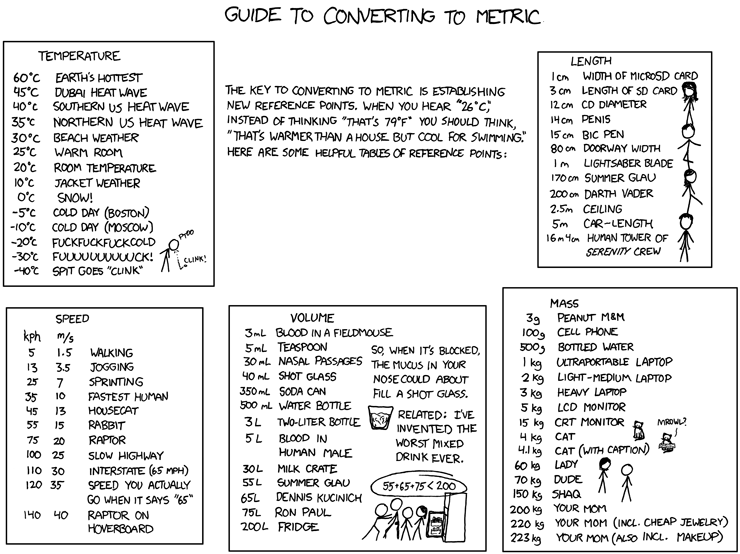 MEASUREMENTSPhysical Quantity
 is a quantity that can be measured and consists of a numerical magnitude and a unit.
Base Quantities; there's 7 of them; length (m), mass (kg), time (s), electric current (A), thermodynamic temperature (K), luminous intensity (cd) and amount of substance (mol). They have their corresponding SI Units (symbols in brackets).
Derived Quantities are derived from base quantities, such as speed (derived from length and time)
Vector Quantities have directions associated with the magnitude.
Scalar Quantities only consist of the magnitude and not the direction.
 KINEMATICS
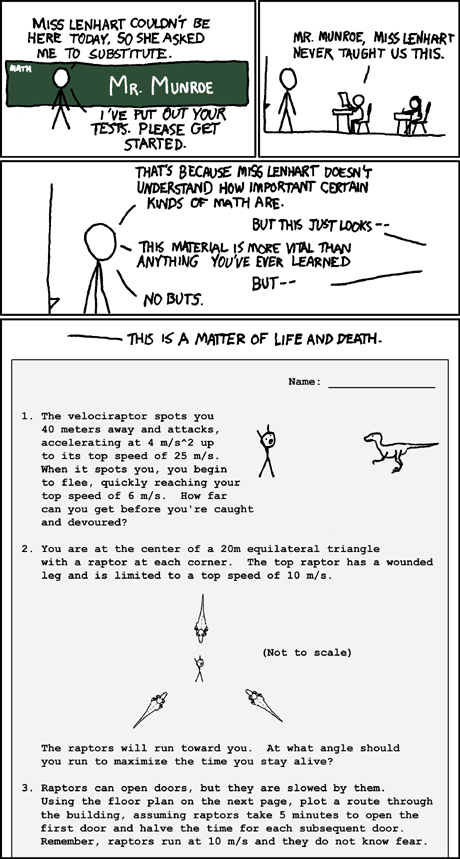
Speed is the distance moved per unit time.
Displacement is the distance moved in a particular direction.
Velocity is the rate of change of displacement
Acceleration the rate of change of velocity.
Terminal Velocity is the maximum constant velocity with air resistance.
FORCES
Force is a push or pull that 1 object exerts on another and tends to produce a motion.
State of Equilibrium are 2 forces acting on an object in opposite directions where the forces balance out, thus the object remains at rest or continues in uniform motion in a straight line as there is no resultant moment.
Newton's 1st Law of Motion: Every object will continue in its state of rest or uniform motion in a straight line unless a resultant force acts on it to change its state.
Newton's 2nd Law of Motion: When a resultant force acts on an object of constant mass, the object will accelerate and move in the direction of the resultant force. F=ma.
Newton's 3rd Law of Motion: For every action, there is an equal and opposite reaction, and these forces act on mutually opposite bodies.
1 Newton is the force that will produce an acceleration of 1 m s-2 on a mass of 1kg.
Friction opposes motion between two surfaces in contact.
 MASS, WEIGHT & DENSITY
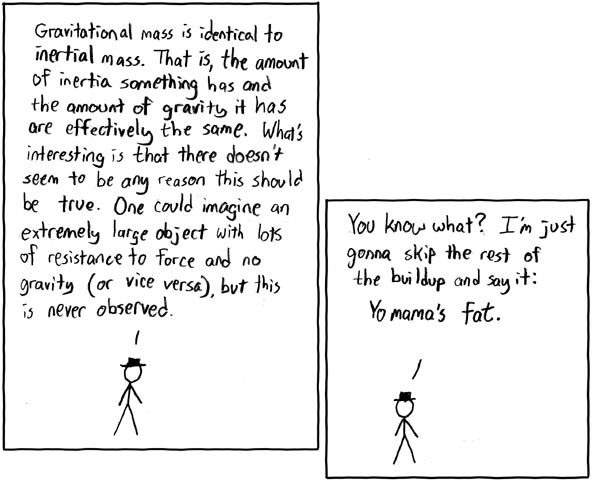
Mass is the amount of matter in a body (kg).
Weight is a force and has direction (N).
Density is the mass per unit volume (kg m-3).
Inertia is the reluctance of the object to change its state of rest or motion.
Gravitational Field Strength is the gravitational force acting per unit mass of an object.
 TURNING EFFECTS OF FORCES
Moment (Torque) is the turning effect of a force about a pivot, calculated by the product of the force and perpendicular distance from the pivot to the line of action.
Principle of Moments: When a body is in equilibrium, the sum of clockwise moments = the sum of anticlockwise moments about a pivot.
Centre of Gravity is the point through which an object's whole weight appears to act for any orientation of the object.
Stability is the ability of an object to return to its original position after being tilted slightly.
 WORK, ENERGY, POWER
Work is done when a force moves its point of application in the direction of the force. If the force moves at right angles to the direction of the force, then no work has been done.
Energy is the capacity to do work (J) such as potential and kinetic energy.
Kinetic Energy is the energy possessed due to the motion of an object.
Potential Energy is the energy possessed by a body due to its position.
Principle of Conservation of Energy: Energy can neither be created nor destroyed in any process. It can be converted from 1 form to another or transferred from one body to another, but the total amount remains constant.
1 Joule is the work done by a force of 1 newton which moves an object through a distance of 1 metre in the direction of the force.
1 Watt is the rate of work done or energy conversion of 1 joule per second (unit for power).
PRESSURE
Pressure is the force acting per unit area (N m-2, or Pa).
Atmospheric Pressure at sea level is 1 atmosphere (or 101325 Pa).
TEMPERATURE
Temperature is how hot or cold an object is.
Heat is the amount of thermal energy being transferred from a hotter region to a colder region.
KINETIC MODEL OF MATTER
Brownian Motion is the random, irregular motion of smoke particles in air (due to the collision of air particles with the smoke particles).
Solids have closely packed atoms or molecules, strong intermolecular bonds, and atoms or molecules vibrate about fixed positions.
Liquids have atoms or molecules occurring in clusters, slightly farther apart as compared to solids and are free to move around between clusters.
Gases have particles or molecules very far apart with negligible forces of attraction between particles moving at high speed and in random and independent motion.
Laws for Molecular Models of an Ideal Gas1. Pressure Law: At constant volume, the pressure of a gas is proportional to ts temperature in kelvin.
2. Charles's Law: At constant pressure, the volume of a gas is proportional to its temperature in kelvin.
3. Boyle's Law: At constant temperature, the pressure of a gas is inversely proportional to its volume.
TRANSFER OF THERMAL ENERGY
Conduction is the transfer of heat through a substance due to collisions between neighbouring vibrating particles (free electron diffusion or molecular vibration).
Convection is the transfer of heat through a substance due to the movement of particles between regions of different temperatures as there is change in densities of various parts of fluids. Can occur in gas or liquid.
Convection Currents is where faster moving particles rise as they are less dense and slower moving particles in the colder regions fall as they are more dense. Cooler, denser air sinks, forcing warm, less dense air upwards.
Radiation is the emission of infra-red waves from surfaces of bodies with temperature above absolute zero (0K) without aid of a medium.
Radiant Heat is the thermal energy from infra-red waves.
Good Conductors of Heat are substances where heat can quickly transfer through.
THERMAL PROPERTIES OF MATTER
Heat Capacity is the amount of thermal energy required to raise the temperature of a body by 1K or 1ºC.
Specific Heat Capacity is the amount of thermal energy required to raise the temperature of 1kg (mass) of a substance by 1K or 1ºC.
Boiling is the process by which a liquid changes to gas at constant temperature (boiling point).
Melting is the amount of energy required to absorb in order to change 1kg of substance from solid to liquid state at melting point.
Freezing is the process by which a liquid changes to solid state at freezing point (same as melting point).
Condensation is the change of state from vapour to liquid
Evaporation is the process by which a liquid changes to vapour at temperatures below and above boiling point of the liquid.
Latent Heat is the energy released or absorbed during a change of state.
Latent Heat of Fusion is the amount of thermal energy required to change the state of matter (solid to liquid, and vice versa) without a change in temperature at melting and freezing point.
Specific Latent Heat of Fusion is the amount of thermal energy required to change 1kg of the solid to liquid or vice versa at melting point, without any change in temperature.
Latent Heat of Vaporization is the amount of thermal energy required to change the state of matter from liquid to vapour or vice versa at boiling point without any change in temperature.
Specific Latent Heat of Vaporization is the amount of thermal energy required to change 1kg of matter from liquid to vapour or vice versa at boiling point without any change in temperature.
Labels: Physics